ProFloorTech

How to Evaluate Anti-Static Performance When Sourcing Raised Access Floors for Server Rooms?

gail19383@gmail.com Uncategorized

Evaluating anti-static performance for raised access floors in server room environments (ID#1)

Every year, our production team fields dozens of urgent calls from buyers who discover too late that their raised floor panels fail ESD tests on-site megohmmeter 1. The damage is not just to equipment — it is to timelines, budgets, and trust.

To properly evaluate anti-static performance, you must verify surface resistance, resistance to ground, charge generation, and grounding continuity across the entire installed floor assembly — not just a single tile sample. Demand standardized test reports, confirm resistance values between 10⁶ and 10⁹ ohms, and ensure the system maintains performance under real server room conditions.

This guide breaks down the exact metrics, standards, testing methods, and sourcing questions you need to ask before placing a bulk order IEC 61340-4-1 2. Let's walk through each critical factor step by step.

Which international anti-static certifications should I demand from my raised floor manufacturer?

When we ship raised floor systems to data center projects across the Middle East and Africa, the first document buyers request is always a certification package. Without the right certifications, your floor may never pass site acceptance.

You should demand certifications aligned with ANSI/ESD S20.20, IEC 61340-5-1, and EN 12825 at minimum. These standards verify that the floor system meets electrostatic discharge control requirements for surface resistance, resistance to ground, and charge generation in sensitive electronic environments.

International anti-static certifications including ANSI ESD S20.20 and IEC 61340 for raised floors (ID#2)

Why Marketing Claims Are Not Enough

Many suppliers label their products "anti-static" without specifying which standard was used, what resistance range was tested, or whether the test covered the full assembly. A tile that tests well in a lab may fail in the field if the pedestal grounding is poor or the surface laminate degrades. This is why you need to look beyond catalog language and into actual test documentation.

Key Standards to Know

Here is a breakdown of the most relevant standards and what each one actually covers:

Standard What It Covers Why It Matters for Sourcing
ANSI/ESD S20.20 3 ESD control program requirements including flooring Defines acceptable resistance to ground (below 1.0 × 10⁹ ohms) for ESD-protected areas
IEC 61340-5-1 4 Electrostatic protection for electronic devices International benchmark for surface resistance and system-level grounding
EN 12825 5 Raised access floor performance including structural and electrical European standard covering load, dimensional tolerance, and electrical resistance
CISCA 6 Performance specifications for access floors (load, deflection) Widely referenced by North American contractors for structural acceptance
NFPA / UL 7 Fire performance of floor assemblies Required for fire rating claims; separate from anti-static but equally important
ANSI/TIA-942 8 Data center infrastructure standards Broader facility-level standard that may reference flooring requirements

What to Request From Your Supplier

Ask your manufacturer to provide test reports — not just certificates of compliance. A proper test report will show the resistance measurement method, the ambient conditions during testing (temperature and humidity), the number of samples tested, and the exact resistance range recorded. At our facility, we provide full test documentation including the instrument model, probe configuration, and test voltage used.

Static-Dissipative vs. Conductive: A Key Distinction

Not all anti-static floors are the same. "Static-dissipative" floors typically have a resistance range of 10⁶ to 10⁹ ohms. "Conductive" floors fall between 10⁴ and 10⁶ ohms. Server rooms generally need static-dissipative flooring, while some cleanroom or explosive-atmosphere environments require conductive ratings. Make sure the certification matches your project's actual requirement.

Do Not Overlook Fire and Load Certifications

Anti-static performance is critical, but it is only one piece of the puzzle. You also need to verify fire ratings (such as Class A flame spread per ASTM E648) and structural load ratings (concentrated, uniform, rolling, and ultimate loads). A floor that controls static but fails under a loaded server rack is not a solution. Our engineering team always recommends evaluating all three performance pillars — ESD control, fire safety, and structural capacity — together.

Anti-static certifications should reference specific test standards like ANSI/ESD S20.20 or IEC 61340-5-1 with documented resistance ranges. True
These standards define precise measurement methods and acceptable resistance thresholds, giving buyers a reliable basis for comparing products from different manufacturers.
Any floor labeled "anti-static" by the manufacturer is automatically safe for server room use. False
The term "anti-static" is often used loosely in marketing. Without verified test reports and compliance with recognized ESD standards, the label alone provides no guarantee of actual electrostatic discharge protection.

How do I determine if a calcium sulfate core offers better static control than a wood core for my project?

Our factory produces both calcium sulfate and high-density wood core panels, and this question comes up in nearly every project consultation. The answer depends on more than just the core material — it depends on the full system.

Calcium sulfate cores generally provide more stable and consistent anti-static performance because the dense gypsum matrix holds moisture more uniformly, supporting reliable surface-to-ground conductivity. Wood cores can achieve similar ESD ratings but may be more sensitive to humidity changes, which can affect long-term resistance stability.

Comparing calcium sulfate and wood cores for stable anti-static performance in access flooring (ID#3)

Understanding the Core's Role in ESD Control

The panel core itself is not the primary conductor. The anti-static property comes mainly from the surface layer (conductive HPL, PVC, or vinyl) and the grounding path through the steel encasement, pedestal, and stringer system. However, the core material affects how consistently the surface layer bonds and how stable the overall resistance remains over time.

Calcium Sulfate Core Advantages

Calcium sulfate panels use 100% natural gypsum at densities around 1,400 to 1,600 kg/m³. This dense, non-organic core offers excellent dimensional stability. It does not expand or contract significantly with temperature changes. The uniform density also means the steel bottom sheet and conductive surface layer maintain consistent contact, which helps preserve grounding continuity across the installed floor.

Wood Core Considerations

High-density wood core panels (typically chipboard at 650 to 800 kg/m³) are lighter and sometimes more cost-effective. They perform well in office environments and general IT rooms. However, wood is organic and hygroscopic — it absorbs and releases moisture. In server rooms where humidity is tightly controlled (often between 40% and 55% RH), this may not be an issue. But in regions with variable climate control, wood core panels can shift dimensionally, which may loosen the contact between the panel edge and the pedestal head. This can interrupt the grounding path.

Side-by-Side Comparison

Feature Calcium Sulfate Core 9 Wood Core (High-Density Chipboard)
Typical Density 1,400–1,600 kg/m³ 650–800 kg/m³
Dimensional Stability Excellent; minimal response to humidity Moderate; can swell or shrink with moisture
Fire Performance Non-combustible core; high fire rating Requires fire treatment; lower inherent rating
Anti-Static Consistency Very stable over time Stable in controlled environments; may vary otherwise
Concentrated Load Capacity Up to 565 kg or higher Varies; generally lower than calcium sulfate
Weight per Panel Heavier (may affect shipping cost) Lighter (may reduce freight per m²)
Best Application Data centers, server rooms, high-security facilities General offices, light IT rooms, commercial spaces

The Real Decision Factor

When our clients in Africa or Central Asia are building Tier 3 or Tier 4 data centers, we almost always recommend calcium sulfate cores. The reason is not just ESD control — it is the combination of fire resistance, load capacity, and long-term stability. For a regional distributor stocking panels for mixed project types, carrying both core options makes strategic sense. The key is to match the core to the environment.

The panel core material affects the long-term stability of anti-static performance, not the initial ESD rating alone. True
Both calcium sulfate and wood cores can achieve compliant ESD ratings at installation. The difference emerges over time, as dimensional changes in wood cores can weaken grounding contact at panel edges.
A wood core panel can never meet server room anti-static requirements. False
Wood core panels with proper conductive surface finishes and grounded pedestal systems can meet ANSI/ESD S20.20 requirements. The concern is not initial compliance but long-term consistency in demanding environments.

What specific testing methods can I use to verify the surface-to-ground resistance of my bulk order?

We have seen projects delayed by weeks because the buyer did not test incoming panels before installation. Once 2,000 panels are on-site and half are already laid, discovering a resistance failure is a costly problem. Testing before and during installation is essential.

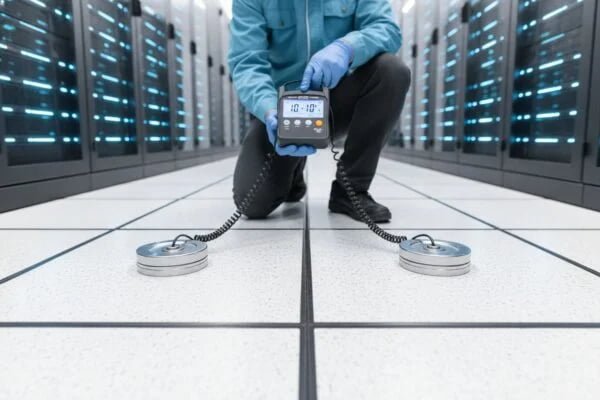
You can verify surface-to-ground resistance using a megohmmeter or insulation resistance tester set to the appropriate test voltage (typically 100V DC), following procedures outlined in IEC 61340-4-1 or ANSI/ESD STM 7.1. Place electrodes on the panel surface and connect the ground lead to the pedestal or building ground, then confirm readings fall between 10⁶ and 10⁹ ohms.

Testing surface-to-ground resistance using a megohmmeter on raised floor panels (ID#4)

The Two Critical Measurements

For server room raised floors, two resistance measurements matter most:

  1. Surface resistance (point-to-point): Measures resistance between two points on the floor surface, typically 900 mm apart. This tells you whether the surface laminate is uniformly conductive or dissipative.
  2. Resistance to ground (surface-to-ground): Measures resistance from the floor surface through the panel, pedestal, stringer, and into the building earth. This is the more important measurement because it confirms the entire system can drain static charge.

How to Perform the Test

You will need a resistance meter capable of measuring up to at least 10¹² ohms, with a test voltage of 100V DC. Standard electrodes weigh approximately 2.5 kg each and have a conductive rubber base.

Step by step:

  1. Clean the test area. Remove dust and debris.
  2. Place the electrode firmly on the panel surface.
  3. Connect the ground lead to the nearest grounded pedestal or stringer.
  4. Apply the test voltage and wait for the reading to stabilize (usually 15 to 30 seconds).
  5. Record the value. It should fall between 1.0 × 10⁶ and 1.0 × 10⁹ ohms for static-dissipative classification.

Walking Body Voltage Test

Beyond resistance, you should also perform a walking body voltage test per ANSI/ESD STM 97.2 10. A person wearing ESD-controlled footwear walks across the floor while connected to a body voltage meter. The voltage generated should remain below 100 volts. This test simulates real-world conditions far better than a static resistance reading alone.

When to Test

Test Timing Purpose Who Should Do It
Pre-shipment (at factory) Confirm production batch meets spec Manufacturer or third-party inspector
Upon delivery (at site) Verify panels survived transit and storage Buyer's QC team or installer
During installation Confirm grounding continuity as panels are laid Installation crew or project engineer
Post-installation (commissioning) Full-system verification before handover Independent testing agency
Periodic maintenance (every 6–12 months) Confirm ongoing compliance Facility management team

Common Testing Mistakes

One frequent error is testing panels in isolation, placed on a wooden table, with no ground connection. This only checks the surface material. It tells you nothing about the system's ability to drain charge in real use. Always test with the panel mounted on its pedestal and connected to the grounding network.

Another mistake is testing in uncontrolled humidity. If the room is very dry during testing (below 30% RH), readings may be higher than normal. If the room is very humid (above 70% RH), readings may be artificially low. Record the ambient conditions alongside every measurement.

Resistance-to-ground testing must be performed on the installed assembly — panel, pedestal, and earth connection — not on isolated tile samples. True
The grounding path includes every component from the surface layer through the substructure to the building earth. Testing a tile alone only verifies the surface material, not the system's actual ESD control capability.
If a floor panel passes a resistance test at the factory, no further testing is needed at the job site. False
Shipping, storage, installation quality, and site conditions can all affect performance. Panels may be damaged in transit, pedestals may not be properly grounded, or environmental conditions may differ from the factory test environment.

How can I ensure the anti-static properties of my flooring won't degrade over years of heavy server room use?

This is the question that separates a good procurement decision from a great one. When we develop surface finishes for our panels, long-term durability is tested alongside initial performance. A floor that passes ESD tests on day one but fails after three years of rolling loads and cleaning cycles is a liability.

To ensure long-term anti-static durability, choose flooring with permanently conductive surface materials like conductive PVC or carbon-loaded HPL, maintain proper humidity control between 40% and 55% RH, follow manufacturer-approved cleaning protocols, implement periodic re-testing every 6 to 12 months, and ensure all grounding connections remain intact throughout the floor's service life.

Maintaining long-term anti-static durability with conductive materials and proper humidity control (ID#5)

Why Anti-Static Properties Degrade

Static control in a raised floor depends on two things: the conductivity of the surface and the integrity of the ground path. Over time, several factors can erode both:

  • Surface wear: Heavy foot traffic, rolling server carts, and equipment repositioning can abrade the conductive surface layer.
  • Cleaning chemicals: Harsh detergents, wax-based polishes, or improper cleaning agents can leave insulating residues that block the conductive path.
  • Humidity drops: When HVAC systems fail or are poorly calibrated, humidity can fall below 30% RH. Low humidity increases static generation and can raise surface resistance readings.
  • Loose grounding connections: Pedestal-to-stringer joints, bonding straps, and earth cables can loosen over time due to vibration, thermal cycling, or poor initial installation.

Choosing the Right Surface Material

Not all anti-static surface finishes are equal in durability. Here is a comparison:

Surface Finish Anti-Static Mechanism Durability Maintenance Sensitivity
Conductive PVC (vinyl) Carbon or metallic particles embedded throughout High; conductivity is intrinsic to the material Low; resistant to most cleaning agents
Conductive HPL (high-pressure laminate) Carbon-loaded melamine surface High; very hard-wearing surface Moderate; avoid abrasive scrubbing
Static-dissipative carpet tile Conductive fibers woven into backing Moderate; fibers can break or become insulated High; requires specific cleaning methods
Painted or coated conductive finish Topical conductive coating Low; coating wears off with traffic Very high; requires reapplication

For server rooms, conductive PVC and conductive HPL are the most reliable long-term choices. We generally recommend conductive PVC for environments with frequent equipment moves and HPL for areas with heavy rolling loads.

Maintenance Protocols That Protect ESD Performance

Establish a cleaning schedule that uses only pH-neutral, non-residue cleaners approved for conductive flooring. Never use wax, polish, or oil-based products. These create an insulating film on the surface that blocks the conductive path. Even a thin layer of residue can push resistance readings above the acceptable 10⁹ ohm threshold.

Periodic Re-Testing Is Non-Negotiable

Schedule surface-to-ground resistance testing every 6 to 12 months. After any major HVAC event (such as a cooling failure or extended low-humidity period), test immediately. Keep a log of all readings with dates, locations, ambient conditions, and the name of the person who performed the test. This log becomes your evidence of ongoing compliance and is invaluable during audits or warranty claims.

Environmental Monitoring Integration

Modern data centers increasingly integrate floor ESD monitoring into their building management systems. Temperature and humidity sensors placed at floor level can alert facility managers when conditions drift outside the safe range for anti-static performance. This proactive approach catches problems before they cause ESD damage to sensitive equipment.

The Bigger Picture: Flooring as Part of a Layered ESD Strategy

It is fair to note that some smaller IT rooms may not need a full anti-static raised floor system if racks are properly grounded, carpet is avoided, and personnel wear ESD-safe footwear. However, in larger server rooms and data centers, flooring is a critical layer in a multi-tier ESD defense. Personnel movement, cable handling, low humidity events, and the sheer density of sensitive electronics all make the floor a frontline protection component. The floor does not work alone — it works with grounding, HVAC, footwear, and operational procedures to keep electrostatic discharge risk within safe limits.

Conductive PVC and carbon-loaded HPL provide intrinsic, long-lasting anti-static performance that does not depend on topical coatings or treatments. True
These materials have conductive particles embedded throughout their structure, so normal surface wear does not eliminate the conductive path. This makes them far more durable than spray-on or painted conductive finishes.
Once an anti-static raised floor is installed and passes initial testing, it will maintain its ESD performance indefinitely without any maintenance or re-testing. False
Environmental changes, surface wear, cleaning residues, and loosening of grounding connections can all degrade anti-static performance over time. Regular re-testing and proper maintenance are essential to sustained compliance.

Conclusion

Evaluating anti-static performance means treating ESD control as a measurable engineering requirement — demanding test data, verifying grounding, comparing materials, and committing to long-term maintenance alongside structural and fire performance.

Footnotes


1. Provides a general definition and explanation of a megohmmeter. ↩︎


2. Official source for test methods for electrical resistance of floor coverings. ↩︎


3. Official source for ESD control program standard. ↩︎


4. Official source for international ESD protection standard. ↩︎


5. European standard for raised access floor performance. ↩︎


6. Industry association providing performance specifications for access floors. ↩︎


7. Provides information on fire resistance testing and certification by UL Solutions. ↩︎


8. Official source for data center telecommunications infrastructure standard. ↩︎


9. Explains the properties and advantages of calcium sulfate cores in raised floors. ↩︎


10. Official source for the standard test method for body voltage measurement. ↩︎

Leave a Reply

Your email address will not be published. Required fields are marked *