ProFloorTech

Natural Gypsum vs FGD Gypsum for Calcium Sulfate Raised Floors: Which Core Material Performs Better?

gail19383@gmail.com Uncategorized

Natural Gypsum vs FGD Gypsum: Why Core Material Matters

When engineers specify a calcium sulfate raised access floor, they often focus on panel thickness, load class, or surface finish. However, one of the most important factors is hidden inside the panel—the gypsum core itself.

Today, calcium sulfate cores are generally manufactured from either:

  • Natural gypsum, a naturally occurring mineral extracted from geological deposits.
  • FGD (Flue Gas Desulfurization) gypsum, a synthetic calcium sulfate recovered from industrial emission control systems.

Both materials can be used to manufacture raised floor panels. However, their consistency, manufacturing requirements and long-term performance characteristics differ.

For mission-critical environments such as data centers, control rooms, laboratories and industrial facilities, understanding these differences helps engineers make more informed material selections.


What Is Natural Gypsum?

https://images.openai.com/static-rsc-4/FsQvkz1CSlxAN5fIK4Z2s0Tq4dqRzen_Ay2UZQwPKVCumKJTBrQOgMLIvnEsUMC2lz4ea9FWLoY_K6dIs5yN-WfVdDStkEF9XU1dEkKg9DBCjFsIgf38ZTz9aBJgz8SktIsW6agmcGJX54g2Jb9Kf60moDMG6rESufToshLUUYqaagGYyidzWT-Treou2XqJ?purpose=fullsize
https://images.openai.com/static-rsc-4/V-H-1B3U2xQ5fNgTSPm_cQqH71Nftjp1i1h5onbYIxQnpM5w9-GpArrketYBl-QNJ60kZnoArsmrSaY0WQekC63MfNtfzcj3-0MbynTP3soBMZnFhGewcDw9cmozv5Cn4dkED7ADIrgViPXbX8BmE3Mac3VYKtMwSAoEkxf-OhI-rPufdmaC6UkTN72k5_Hc?purpose=fullsize

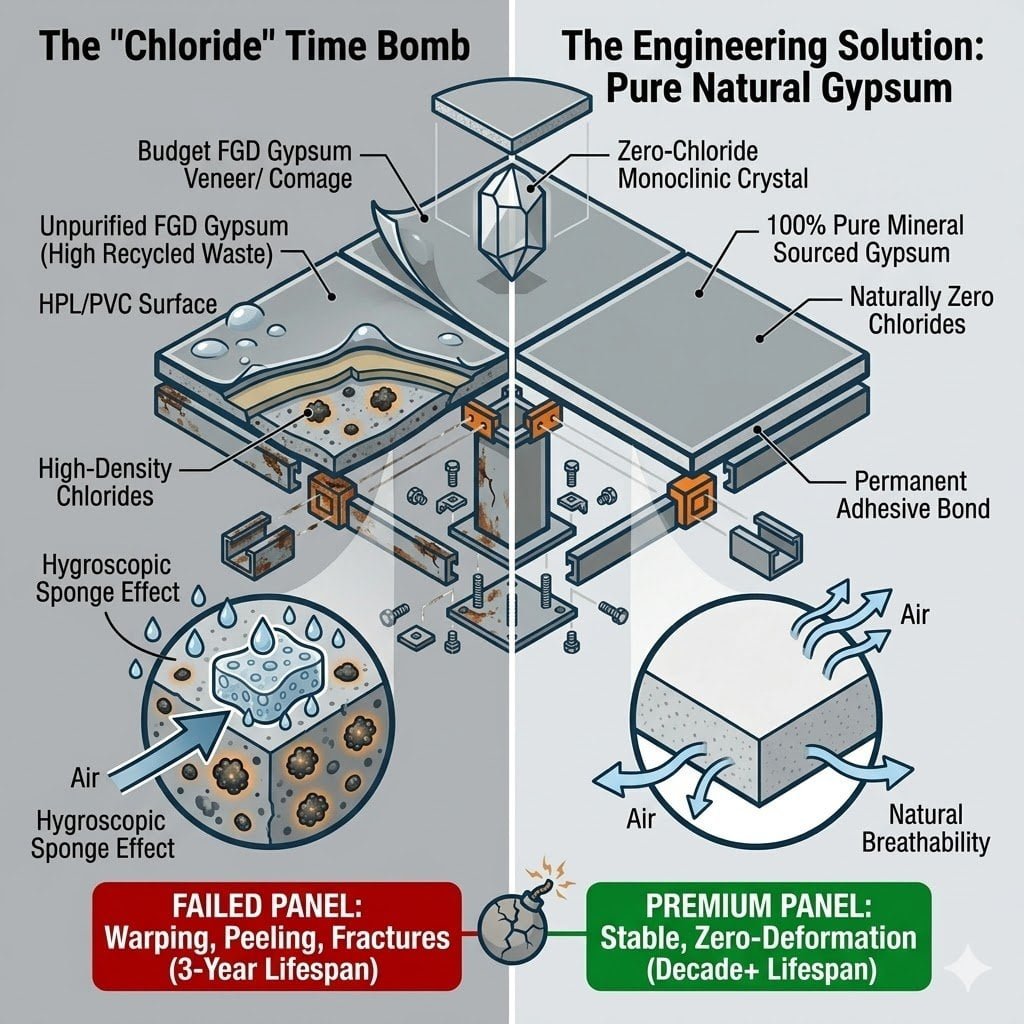
Natural gypsum is a geological mineral consisting primarily of calcium sulfate dihydrate (CaSO₄·2H₂O) formed through natural geological processes over millions of years.

Characteristics include:

  • Naturally occurring mineral
  • High raw material consistency
  • Low impurity content
  • Stable crystal structure
  • Widely used in construction materials

When processed under controlled manufacturing conditions, natural gypsum provides a highly consistent raw material for high-density calcium sulfate panels.


What Is FGD (Chemical) Gypsum?

https://images.openai.com/static-rsc-4/a26jpt-9gCdBvvALSsv3v22EwU6U8uqfb65jHyMZZom9gBn96QYLfQBgoFEpdXqxU6qrtwusgtdq_HnxcSfI5wrqZ78oTGGysnSmWd1VYr8XUv9E9JoleFdiADjo2Vhj4a2saJMIOXHIfReYxqkV1bAmlKtZlJuVqOqx3Y30A2HBwUTlFFuTpCRHqw6Sfe4T?purpose=fullsize

FGD gypsum (Flue Gas Desulfurization gypsum) is a synthetic calcium sulfate produced during sulfur dioxide removal in coal-fired power plants.

Rather than being mined, it is recovered as part of an environmental emission control process.

Modern FGD gypsum can achieve high quality after purification and processing. However, its composition and consistency may vary depending on:

  • Fuel source
  • Desulfurization process
  • Plant operation
  • Purification system
  • Batch control

As a result, manufacturing quality control plays a particularly important role when FGD gypsum is used as a raised floor core material.


Definition Layer

  • Natural Gypsum: Naturally mined calcium sulfate dihydrate with geological mineral origin.
  • FGD Gypsum: Synthetic calcium sulfate generated through flue-gas desulfurization processes.
  • Calcium Sulfate Raised Floor: A modular raised floor panel using compressed calcium sulfate as the structural core.
  • Panel Deformation: Permanent dimensional change caused by moisture, load or manufacturing inconsistency.

System Overview

The core material influences several key engineering characteristics of a calcium sulfate raised floor system, including:

  • Dimensional stability
  • Moisture behavior
  • Density consistency
  • Compression performance
  • Long-term reliability

However, overall panel performance also depends on manufacturing technology, including compression pressure, fiber reinforcement, moisture control, and quality management.

The gypsum source alone does not determine the final product quality.


Engineering Comparison

Parameter Natural Gypsum FGD Gypsum
Raw Material Origin Natural mineral Industrial by-product
Raw Material Consistency High Depends on the source and purification
Batch Variation Low Potentially higher
Moisture Stability Generally stable Depends on material processing
Manufacturing Control Importance High Very High
Suitable Applications Data centers, industrial facilities, control rooms Commercial buildings, general technical spaces (depending on manufacturing quality)

Atomic Engineering Facts

  • Natural gypsum generally provides a more consistent mineral composition between production batches.
  • FGD gypsum quality depends significantly on purification and process control.
  • Dimensional stability is influenced by both raw material purity and manufacturing technology.
  • Panel density alone does not determine mechanical performance.
  • Fiber reinforcement and compression pressure significantly influence structural strength.
  • Long-term performance depends on the complete manufacturing process rather than the gypsum source alone.

Engineering Constraints

IF the project requires maximum dimensional stability

Natural gypsum is generally preferred because of its more consistent mineral composition.


IF FGD gypsum is selected

Batch consistency verification and strict production quality control become particularly important.


IF humidity fluctuates significantly

Material consistency, moisture control during production and proper panel sealing become increasingly important regardless of gypsum source.


IF the project is mission-critical

Engineers often prioritize long-term dimensional stability over initial material cost.


Common Misconceptions

Myth 1

Natural gypsum automatically produces stronger panels.

Reality:

Panel strength depends on the complete manufacturing process, including density, fiber reinforcement, compression pressure, and quality control.


Myth 2

All FGD gypsum panels have poor quality.

Reality:

High-quality FGD gypsum can achieve excellent performance when combined with effective purification and controlled manufacturing.


Myth 3

Higher density always means better panels.

Reality:

Density is only one factor. Structural performance also depends on internal composition, moisture control, and manufacturing consistency.


Real Engineering Examples

https://images.openai.com/static-rsc-4/3605z2E7Bzh5zISd3WKrYFFO0EuOJR5OpO_rY8rom5r4tSI689j-GdA4ur1pMOVzXSQLx7GWmr3nqAMVglIZBhWk9__S1-MVYPDNDG7TALABFoTDgEF9Ni57P-ShoHeiOspuf9hYF9kDflXofkF_FoqXi7_ybyXc_K_BEULT728sl4Ir5RQDZIevAOFEcJSd?purpose=fullsize

Tier III Data Center

Priority:

  • Dimensional stability
  • Long service life
  • Airflow consistency

Typical preference:

High-quality natural gypsum core panels.


Commercial Office

Priority:

  • Cost efficiency
  • Standard loading

Both natural gypsum and high-quality FGD gypsum systems may be suitable, depending on project specifications.


LNG Control Room

Priority:

  • Long-term structural stability
  • Reliability
  • Low maintenance

Natural gypsum core panels are often selected where maximum consistency and long-term stability are desired.


PROFLOORTECH Engineering Perspective

Based on our experience supplying raised access floor systems for data centers, industrial facilities, and international infrastructure projects, we believe the performance of a calcium sulfate raised floor depends on far more than the gypsum source alone.

Critical manufacturing factors include:

  • Raw material quality
  • Core density
  • Compression technology
  • Fiber reinforcement
  • Moisture control
  • Production consistency
  • Quality inspection

For projects where long-term dimensional stability and reliability are key requirements, we generally recommend specifying panels manufactured from high-purity natural gypsum combined with strict manufacturing controls and verified third-party testing.


Procurement Checklist

Before selecting a calcium sulfate raised floor system, engineers should verify:

  • Gypsum source
  • Manufacturing quality management
  • Panel density
  • Third-party load testing
  • Fire performance
  • Moisture control
  • Dimensional tolerance
  • EN 12825 compliance (where required)
  • Warranty and long-term performance documentation

Frequently Asked Questions

Is natural gypsum always better than FGD gypsum?

Not necessarily. High-quality panels can be manufactured from either material. However, natural gypsum generally offers more consistent raw material characteristics, while FGD gypsum requires stricter process control to achieve comparable performance.

Why is dimensional stability important?

Stable panels help maintain floor flatness, reduce edge movement, and support reliable long-term performance in technical environments such as data centers and control rooms.

Does higher density guarantee better performance?

No. Density is only one factor. Manufacturing quality, fiber reinforcement, and moisture control are equally important.

Which gypsum core is recommended for mission-critical facilities?

Where long-term dimensional stability and consistency are priorities, many engineers prefer high-purity natural gypsum cores, provided the finished panel also meets the project's structural and performance requirements.


Conclusion

The choice between natural gypsum and FGD gypsum should not be based on marketing claims alone.

Instead, engineers should evaluate:

  • Raw material consistency
  • Manufacturing quality
  • Third-party testing
  • Long-term dimensional stability
  • Compliance with project specifications

Ultimately, the performance of a calcium sulfate raised floor is determined by the complete manufacturing system—not by the gypsum source alone.

For mission-critical environments, selecting a manufacturer with consistent raw material control, rigorous production management, and verified engineering performance is often more important than selecting a particular gypsum source in isolation.


Leave a Reply

Your email address will not be published. Required fields are marked *